
Burnout happens when your body and nervous system have been running on empty for too long. It’s not a character failing. It’s a physiological state that rest alone rarely resolves.
CONDITIONS WE TREAT
Burnout
What burnout feels
like in your body
Most descriptions of burnout focus on the emotional and cognitive dimensions. The exhaustion, the cynicism, the mental overload and the sense of being unable to engage. These are real and significant. But burnout also lives in the body in ways that are equally real.
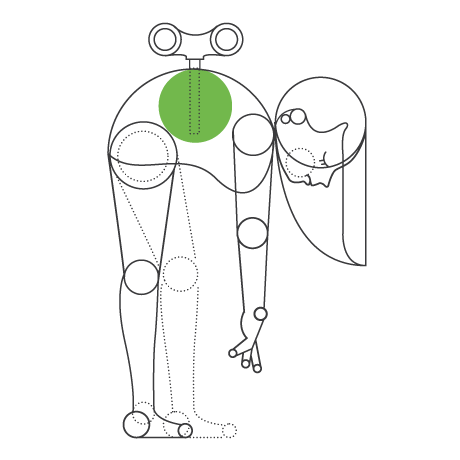
The physical experience of burnout typically includes a profound, bone-deep fatigue that sleep doesn’t fix. A nervous system that’s been “on” for so long it no longer knows how to let go. You’re simultaneously exhausted and unable to rest. Tension is chronically held through the upper back, neck and shoulders. Colds and flus are common due to a depleted immune system. And there’s a physical flatness that is distinct from ordinary tiredness.
This physical dimension matters because it’s not resolved by taking time off. The pattern is held in the body’s structure and nervous system. Until that changes you often find yourself cycling back to the same place, even after a period of rest.
Burnout rarely turns up on its own. If the tension is the loudest part for you, Tension & Stress may fit better. If it’s more wired than flat, look at Stress & Anxiety. Plenty of people recognise themselves in more than one.
How we approach this
Care at Lifewise begins with us understanding your history and experience. We discuss how long things have been this way, what the demands have been and what your body is currently showing. We always meet you where you’re at, and for someone in a depleted state the approach is particularly gentle and paced accordingly.
Network Spinal is well suited to burnout because it works with your nervous system to gently release its stress, rather than forcing it to change. The goal is to help your physiology to begin shifting from its defensive, depleted state towards something more sustainable.
What a first session actually involves
The conversation comes first. Fifteen or twenty minutes on what’s been happening, how long it’s been that way, and what you’ve already tried. Then an assessment of your spine and nervous system, and we’ll explain what we’ve found before anything else happens.
Then you lie fully clothed on a padded table. We make a series of light, precise contacts along your spine, mostly at the neck and the base of the spine, with pauses in between so your body has time to respond. No cracking. No twisting. No force.
If you arrive depleted, we go slower. The work meets your nervous system where it actually is, not where a protocol says it should be.
Allow 60 to 75 minutes for a first visit.
→ How Network Spinal works · → What happens at your first visit
How long this takes
Gradually, and not in a straight line.
The small things come first. Sleeping through. A morning that starts with less weight on it. An hour of energy that feels different in quality to what you’ve been running on. Those windows get wider before anything dramatic happens. Most people describe it as coming back to themselves rather than as a turning point.
After your first visit we’ll give you a straight view of what we think would help and roughly over what period. Not a promise, and no obligation past that first appointment.
When to see someone else
Burnout rarely has one cause, and it rarely needs one kind of help.
This work sits alongside your GP and your psychologist, not instead of them. If you haven’t had bloods done, do that first — there are medical causes of long-term exhaustion worth ruling out, and your GP is the person for it. If low mood is the biggest part of it, that needs its own support. And if the workload that built this hasn’t changed, nothing that happens on the table is going to outlast it.
If that’s what we think is going on, we’ll say so, and we’ll refer you on.
You don’t have to keep running on empty
No referral needed. Your first visit is a private, unhurried conversation and a chance to experience this gentle work. Appointments are available through the week.
Common questions about burnout
Burnout has a physical side that rest doesn’t always reach. A nervous system that won’t switch off, fatigue that sleep doesn’t fix, tension held through the neck and shoulders. Network Spinal works by helping your nervous system to release the stress it’s been storing. It’s why people come here for burnout without having any particular pain to point at.
Because the pattern is held in your body, not in your calendar. Time off lifts the demand. It doesn’t necessarily teach a nervous system how to let go again. That’s why so many people find themselves back where they started within a fortnight of returning.
Yes. The contacts are light, and there’s no cracking, twisting or force at any point. When someone arrives depleted we go slower and the session is shorter. We follow what your body is telling us rather than pushing it to a timetable.
It varies, and anyone giving you a number before meeting you is guessing. Most people notice small changes in the first few visits. The bigger shift is progressive. We’ll give you an honest read after your first visit.
No. A lot of the people we see aren’t in pain at all. They’re running below their own baseline, sleeping badly, holding tension they’ve stopped noticing, or aware they’ve lost an ease they used to have.
No, and it shouldn’t be. This works alongside them. We’ll encourage you to keep that support in place, and we’ll refer you on when we think something else is needed.
Finding us
We’re at 50/81 Carrington Street in the Adelaide CBD, easily reached from across the city. Fees are published in full, and we issue receipts you can claim with your health fund.